All posts

NEC 110.24 requires service equipment at other than dwelling units to be legibly field-marked with the available fault current, along with the date the calculation was performed. The marking has to be durable enough for the environment, and the calculation behind it has to be documented and available to whoever designs, installs, inspects, maintains, or operates the system later.
Most contractors are familiar with the available fault current label. Fewer realize the Code can also require the calculation behind it to be available on request. This makes proper fault current documentation just as important as the label itself.
On this page
- What does NEC 110.24 require?
- Which installations need the label?
- What has to be on an available fault current label?
- What changed between NEC editions?
- Where does the source transformer fault current number come from?
- Does the calculation have to be exact?
- When do you have to recalculate?
- Do downstream panels need labels too?
- What happens if the marking is missing or outdated?
- Getting the number and the documentation together
- FAQ
What does NEC 110.24 require?
NEC 110.24 requires
- a field marking on the service equipment
- documentation of the calculation that produced it
The marking needs to visible, durable and must be updated if something changes in the electrical system that might impact the available fault current / short circuit current. Part A covers field markings and Part B covers modifications.
Adoption varies by jurisdiction, so confirm which edition your AHJ enforces. The requirement has been in the Code since the 2011 edition, and the wording has shifted since.
Which installations need the label?
Service equipment at other than dwelling units. A single-family home does not require the marking. Commercial, institutional, and multi-family service equipment generally does.
There is also an exception for industrial installations, where the conditions of maintenance and supervision are such that only qualified people work on the gear. It covers both the marking in (A) and the recalculation in (B). The reasoning is that facilities meeting that bar already track equipment ratings as a matter of course. It is a narrower exception than it first appears because not all industrial sites qualify, and ultimately the AHJ decides.
What has to be on an available fault current label?
An available fault current label must include the available fault current and the date the calculation was performed. Both are required, so a label showing only a kA value is incomplete.
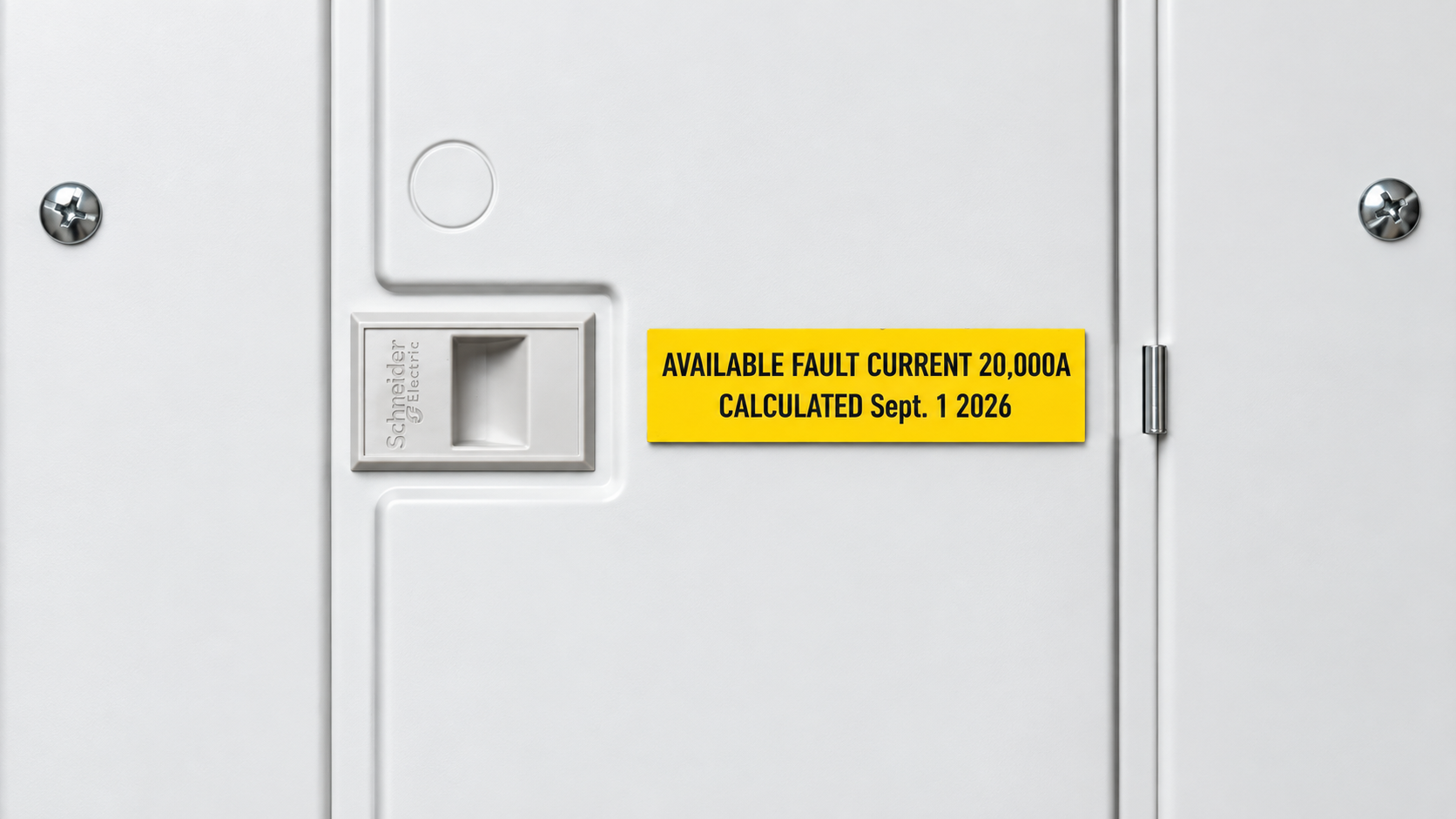
Both required elements on one marking: the available fault current and the date it was calculated.
The marking also has to be legible and hold up where it lives. Through the 2023 edition, the Code words this as durability sufficient for the environment involved. The 2026 edition points to 110.21(B), Field-Applied Hazard Markings, instead. That section sets two requirements: the marking has to be durable enough for the environment and warn of the hazard using effective words, colors, or symbols, and it has to be permanently affixed to the equipment rather than handwritten. Variable portions are excepted, so the fault current value and the calculation date can be filled in by hand as long as they are legible, and sufficiently durable, for example, written with an industrial UV-Resistant Paint Pen.
Either way, an outdoor service in a coastal or industrial setting needs a label that will still be readable years from now, which rules out a printed sheet in a plastic sleeve or a number written on tape.
The date makes it easy for inspectors and electricians to quickly determine whether the calculation is still valid or if the electrical service has changed since it was completed.
2026 NFPA 70 - 110.24 Available Fault Current
(A) Field Marking. Service equipment at other than dwelling units shall be legibly marked in the field with the available fault current. The field markings shall include the date the fault-current calculation was performed and comply with 110.21(B). The calculation shall be documented and made available to those authorized to design, install, inspect, maintain, or operate the system.
(B) Modifications. When modifications to the electrical installation occur that affect the available fault current at the service, the available fault current shall be verified or recalculated as necessary to ensure the service equipment ratings are sufficient for the available fault current at the line terminals of the equipment. The required field markings in 110.24(A) shall be adjusted to reflect the new level of available fault current.
Exception: The field marking requirements in 110.24(A) and 110.24(B) shall not be required in industrial installations where conditions of maintenance and supervision ensure that only qualified persons service the equipment.
2026 NFPA 70 - 110.21 Marking
(B) Field-Applied Hazard Markings. Where caution, warning, or danger hazard markings such as labels or signs are required by this code, the markings shall meet the following requirements:
(1) The marking shall be of sufficient durability to withstand the environment involved and warn of the hazards using effective words, colors, symbols, or any combination thereof.
(2) The marking shall be permanently affixed to the equipment or wiring method and shall not be handwritten.
Exception to (2): Portions of the markings that are variable, or that could be subject to changes, shall be permitted to be handwritten and shall be legible.
Source: NFPA 70, 2026 edition, 110.24 and 110.21(B).
What changed between NEC editions?
Three things worth knowing if your jurisdiction is on an older edition.
| Edition | What changed |
|---|---|
| 2011 | The available fault current marking first appeared, worded as the maximum available fault current |
| 2017 | Added the requirement to document the calculation, so a label printed before that cycle can be fine for its time and still leave you without paperwork |
| 2020 | Dropped the word "maximum," so the marking is the available fault current rather than the maximum available fault current |
| 2026 | Replaced the durability wording with a cross-reference to 110.21(B), which carries the durability requirement forward and adds that the label be permanently affixed |
Editions from 2011 through 2017 asked for the maximum available fault current, and you will still see that phrase on existing labels and in AHJ checklists. AHJs adopt on their own schedule, so verifying requirements with your local AHJ is always recommended.
Where does the source transformer fault current number come from?
Usually the utility. The Code's informational notes point to electric utilities as the source of available fault current values. In practice you get the number one of two ways:
- Request it from the utility. Often supplied as an available fault current at the service point, sometimes as a transformer size and impedance.
- Calculate it. From the transformer kVA and nameplate impedance, then reduced through each conductor run using the point-to-point method.
Either way, the number at the service is only the starting point. Carrying it downstream depends on details the point-to-point method accounts for: actual conductor length and size, copper or aluminum, and whether the run is in ferrous or nonmagnetic raceway. Those are calculation inputs, not something the utility supplies.
Most contractors end up doing both, a utility value where one is available, and a calculation to carry that value downstream to the equipment being installed. The Kopperfield fault current calculator takes either starting point and carries it through every run and piece of equipment in the chain.
Does the calculation have to be exact?
Erring high is the safe direction, and it is standard practice.
A value that overstates what is available is conservative, because equipment selected against it will be rated higher than necessary rather than lower. A value that understates it defeats the entire purpose of the marking, and the equipment selected against it may not be adequate.
This is why the infinite bus method is common for 110.24 marking. Treating the utility supply as an infinite source produces the highest value the transformer could deliver, ignoring upstream impedance that would only reduce it.
When do you have to recalculate?
Whenever a modification affects the available fault current at the service, 110.24 Part (B) requires that the value has to be verified or recalculated to confirm the service equipment ratings are still sufficient, and then the marking updated to match.
Common triggers:
- A service upgrade
- A transformer replacement, on your side or the utility's
- Utility work upstream, including changes at a remote substation
- Added motor load or another source or configuration change that contributes fault current. Ordinary added load, like lighting, receptacles, or resistive equipment, does not necessarily change available fault current and does not by itself trigger recalculation.
- Added generation, including solar and storage, which contributes fault current
The utility-side triggers are the ones that catch people. A utility can raise the available fault current at your customer's service without anyone on site knowing, which is exactly why the calculation date on the label matters.
Do downstream panels need labels too?
Often, yes. 110.24 applies to all service equipment, but it stops at the service. Since the 2020 NEC, 408.6 requires switchboards, switchgear, and panelboards in other than one- and two-family dwellings to be field marked with the available fault current and the calculation date. That includes sub-panels and distribution boards. Earlier editions had no equivalent rule for downstream gear.
Exemptions and equipment coverage vary by edition, and gear like motor control centers and industrial control panels follow their own articles. Check the edition adopted in your jurisdiction and the section that applies to the equipment in front of you. Either way, the value at each point still has to be checked against the AIC and SCCR ratings on the gear installed there.
What happens if the marking is missing or outdated?
It is a Code violation, and on commercial work it is a common inspection failure that is cheap to fix before the inspection, but can be disruptive if it is missed.
Getting the number and the documentation together
The marking at installation time is usually straightforward. Retaining the documentation requirement is what tends to be missing. Under 110.24(A), the calculation "shall be documented and made available" to those authorized to design, install, inspect, maintain, or operate the system (NEC 110.24(A), NFPA 70). A value written on a label is not a documented available fault current calculation.
The Kopperfield fault current calculator produces both. Start from a utility-supplied available fault current or calculate it from the transformer kVA and %Z, add each run and piece of equipment, and you get the available fault current at every point in the chain. Every calculation exports as a branded PDF showing the per-point values with the method and assumptions printed on it, matching the headers on your load calculations and single line diagrams.
That PDF is the documented calculation, and the service value on it is what goes on the label.
Your first two fault current calculations are free with a free Kopperfield account. Unlimited calculations are included in Commercial Pro.
👉 Try the fault current calculator
Frequently asked questions
Does NEC 110.24 apply to houses?
No. The field marking requirement is for service equipment at other than dwelling units, so a single-family home generally does not need the label. Equipment ratings still have to be adequate for the available fault current under 110.9 and 110.10.
What has to be on an available fault current label?
The available fault current and the date the calculation was performed, marked legibly and durably. Editions from 2011 through 2017 asked specifically for the maximum available fault current. The 2026 edition states the durability requirement as compliance with 110.21(B), which also requires the label to be permanently affixed and not handwritten, though the value and the date can be filled in by hand as long as they are legible.
How often does the label need updating?
There is no fixed interval. It has to be updated whenever a modification affects the available fault current at the service, a service upgrade, a transformer change, added generation, or utility work upstream.
Can I use the infinite bus method for the 110.24 label?
It is commonly used, because it produces a conservatively high value and erring high is the safe direction. Confirm your AHJ accepts it, particularly from the 2020 edition onward, which no longer specifies a maximum value.
Who is responsible for the marking?
Typically the installing contractor, though the AHJ has the final say. The utility usually supplies the available fault current value at the service point.
Does the calculation itself have to be provided?
Yes. Since the 2017 edition, the Code has required the calculation itself to be documented and kept available to the people who work on, inspect, or maintain the system. A label alone does not satisfy it.