Try our National Electrical Code online chatbot
Put an NEC assistant in your pocket with Kopperfield's National Electrical Code online chatbot. Answer questions with our free NEC chatbot for questions related to the 2017, 2020, and 2023 NEC.
Ask one of these, or type your own question in the chat.
Assistant
Example answers to National Electrical Code questions
Where in the NEC can I find rules related to EV chargers?
You can find the rules related to Electric Vehicle (EV) chargers in Article 625 of the NEC. This article specifically addresses the installation and requirements for EV supply equipment.
Here's a brief overview of the key sections within Article 625:
- 625.1 Scope: Covers the overall scope of the provisions related to EV charging systems.
- 625.2 Definitions: Provides definitions for terms such as "Electric Vehicle," "Electric Vehicle Supply Equipment," and others relevant to EV charging...
Free, no sign-up.
Can you quiz me with 3 sample NEC code questions?
Sure! Here are three sample NEC-related questions to quiz your knowledge:
Question 1: According to the NEC, what is the unit load in VA per square foot used for calculating general lighting loads in dwelling units?
- a) 1 VA/ft²
- b) 2 VA/ft²
- c) 3 VA/ft²
- d) 4 VA/ft²
Question 2: For a 2000 square foot dwelling unit, what is the minimum general lighting load in volt-amperes (VA) as per the...
Free, no sign-up.
Should I take an EVSE load at 125%? If not, what value is correct?
Yes, the Electric Vehicle Supply Equipment (EVSE) loads should be considered continuous loads, and thus should be taken at 125% for overcurrent protection.
According to the NEC:
625.41 Overcurrent Protection: "Overcurrent protection for feeders and branch circuits supplying EVSE, including bidirectional EVSE, shall be sized for continuous duty and shall have a rating of not less than 125 percent of the maximum load of the equipment. Where noncontinuous loads are supplied from the same feeder, the overcurrent device shall have a rating of not less than the sum of the noncontinuous loads...
Free, no sign-up.
Give me a quick explanation for how to calculate lighting load.
To calculate the lighting load as per the National Electrical Code, follow these steps:
1. Compute the floor area: Measure the total floor area. For a dwelling unit, exclude areas that are not adaptable for future use, unfinished attics, and open porches.
2. General Lighting Load: Use a unit load of 3 VA per square foot for general lighting...
Free, no sign-up.
Are there any changes to trenching rules between the 2017 and 2020 code?
The trenching requirements between the 2017 and 2020 National Electrical Code (NEC) editions have some changes. In particular:
The minimum cover requirements for underground installations as specified in Table 300.5 remain the same in both editions. However, the 2020 NEC adds more explanatory detail and context in some sections, including directives on backfill materials and updates on maximum and minimum burial depths in various scenarios.
There is a specific emphasis on backfill material to prevent damage to raceways, indicating that any backfill containing large rocks, paving materials, and other potentially damaging...
Free, no sign-up.
More tools for your electrical shop
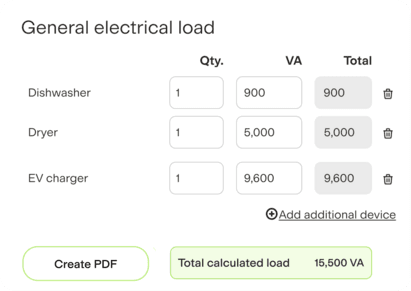
Load calculator
Calculate electrical loads with NEC defaults and downloadable PDFs
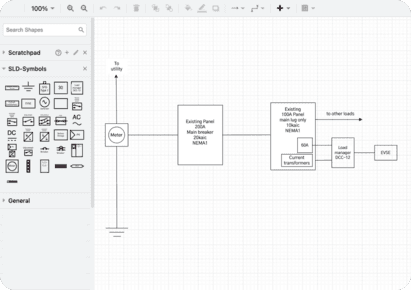
Single line diagrams
Generate single line diagrams from a library of common templates
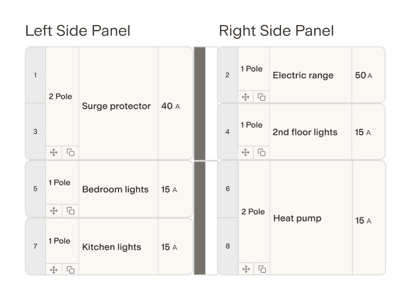
Panel schedules
Drag and drop breakers and edit labels to create custom schedules
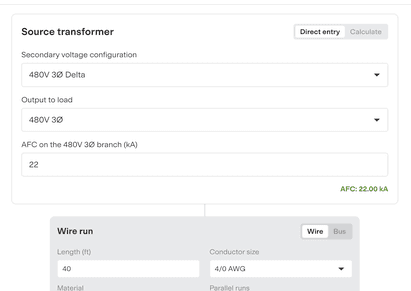
Fault current calculator
Calculate available fault current at every point from transformer to panel
National Electrical Code online chatbot common questions
More questions? Email team@kopperfield.com and we'll get back to you.
The National Electrical Code online chatbot answers questions related to the 2017, 2020, and 2023 NEC, published by the National Fire Protection Association.
Our National Electrical Code online chatbot can be used for a variety of functions, some of which are outlined on this page. Use the chatbot to look up specific codes or sections within the NEC. You can also use the chatbot to assist with rules for calculations and interpretations of the code. If you are preparing for the NEC exam, the chatbot may also be helpful as a test prep and studying resource.
No, Kopperfield is not associated with the National Electrical Code, but the online chatbot answers questions related to the 2017, 2020, and 2023 NEC. This tool is provided for informational purposes only. It is the sole responsibility of the electrician preparing any calculations, permits, or other electrical work to verify and ensure both correctness and compliance with local regulations.
This tool is made for professionals involved in the design, construction, and permitting of electrical systems. This includes electrical contractors, engineers, power system designers, and maintenance technicians. Our tool makes it easy for anyone to reference the National Electrical Code to get quick answers and information.
Send an email to team@kopperfield.com if you're looking for help with the online chatbot. We can help look into your question and share additional information about Kopperfield.