All posts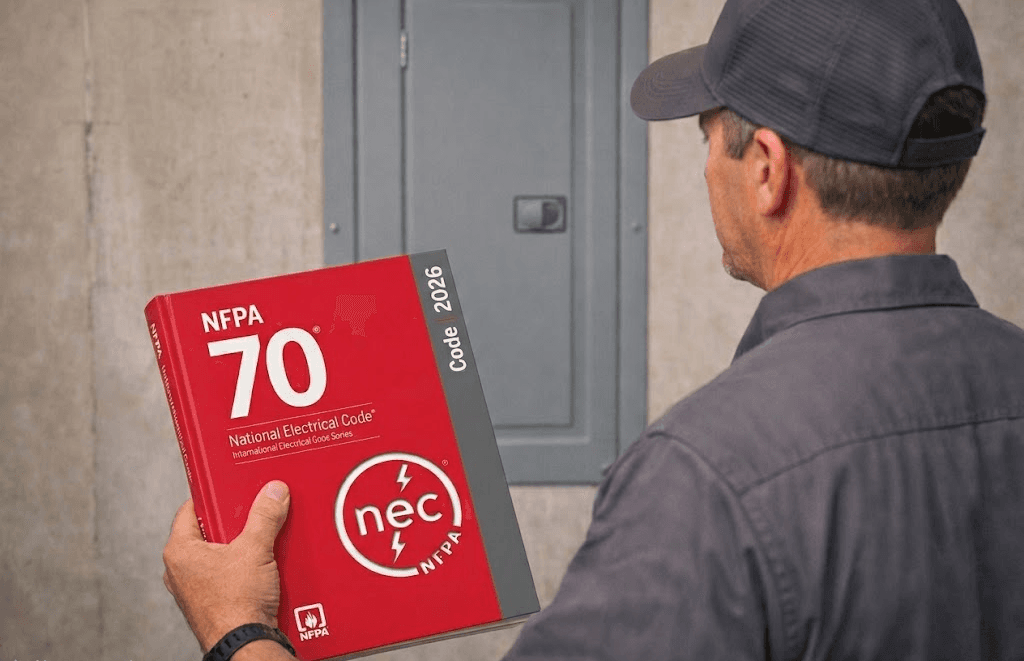
The 2026 National Electrical Code (NEC) introduces the most significant reorganization and clarification of load calculation rules in decades. While many calculation concepts remain familiar, section numbers, demand factors, and assumptions have changed in important ways, especially for dwelling units, EV charging, and existing services.
Electrical load calculations are the foundation of nearly every modern electrical upgrade. They determine whether an existing service can safely support new equipment or whether costly infrastructure changes are required. For residential and light-commercial projects, load calculations directly affect decisions around EV charger installations, heat pump retrofits, generator additions, spas and hot tubs, electric cooking conversions, and panel upgrades. In retrofit scenarios especially, small differences in how loads are calculated can be the difference between approving a permit and triggering a full service upgrade.
Understanding these updates is critical for applying the Code correctly and avoiding outdated assumptions that no longer apply under NEC 2026. This article walks through the key NEC 2026 load calculation changes, section by section, with a focus on practical code interpretation.
Key Changes in 2026
- Complete renumbering of load calculation rules from Article 220 to Article 120
- Explicit removal of the 125% continuous load requirement from load calculations
- Significantly reduced general lighting load for dwelling units per square foot
- More favorable treatment of EVSE loads
- Formal recognition of power control systems
- Greatly expanded demand factor allowances for existing dwelling retrofits
Read on for more detail.
Detailed Look at Changes
Article Renumbering: 220 to 120
- 2023 NEC: Article 220 -- Branch-Circuit, Feeder, and Service Load Calculations
- 2026 NEC: Article 120 -- Branch-Circuit, Feeder, and Service Load Calculations
Nearly all familiar section numbers have changed. While many rules are substantively similar, references must be updated when citing or applying the 2026 NEC.
Section 120.5: General Requirements
Floor Area for Dwelling Units
Section 120.5(C) clarifies that non-habitable detached spaces, such as detached garages, are not required to be included in dwelling unit floor area calculations.
Continuous Loads
Section 120.5(E) states that:
Load calculations shall not require continuous loads to be calculated at 125 percent.
This removes any confusion about whether the 125% factor applies during load calculation itself. The multiplier may still apply for conductor or overcurrent device sizing, but not for load calculations.
Section 120.6: Coincident Loads
The coincident load rules have been simplified. When motors or air-conditioning equipment are involved, the calculation now clearly directs users to compare applicable results and use the larger value, rather than performing layered checks that had confusing language around the inclusion of the largest motor even when it was not in the larger load scenario.
Section 120.7: Power Control Systems
Formerly addressed under energy management provisions, NEC 2026 introduces Power Control Systems (PCS) as a distinct concept.
- The PCS setpoint is treated as a continuous load for calculation purposes.
- This section formally allows dynamic load control to be considered when determining calculated load.
Section 120.13: Branch Circuit Loads for Dwelling Units
NEC 2026 introduces a dedicated section for branch-circuit load calculations in dwelling units.
- 3 VA/ft² is used for determining the number of required branch circuits, but this is separate from feeder and service load calculations
Section 120.14: Specific Loads
Electric Dryers
The branch-circuit load for electric dryers must be calculated using:
- 5,000 W (VA) minimum per dryer, or
- The nameplate rating, whichever is greater
This applies to each dryer served.
Section 120.41: General Lighting Load for Dwelling Units
- 2023 NEC: 3 VA/ft²
- 2026 NEC: 2 VA/ft²
This represents a 33% reduction in the required general lighting load for dwelling units!
Section 120.53: Appliance Demand Factors
The appliance demand factor rules remain conceptually similar to prior editions, with emphasis that:
- Only appliances 500 W or greater are eligible
- A minimum of four qualifying appliances is required before applying the demand factor
Section 120.54: Electric Dryer Demand Factors
The dryer demand factor table has been simplified:
| Number of Dryers | 2023 NEC | 2026 NEC |
|---|---|---|
| 1-2 | 100% | 100% |
| 3-4 | 100% | 80% |
| 5 | 85% | 80% |
Section 120.56: Instantaneous Water Heaters and Kitchen Equipment
NEC 2026 expands this section to include instantaneous electric water heaters, along with commercial kitchen equipment.
As a result, instantaneous water heaters now qualify for demand factor treatment under this section.
Section 120.57: Electric Vehicle Supply Equipment (EVSE)
Minimum Load Requirement
- 2023 NEC: 7,200 W or nameplate, whichever is larger
- 2026 NEC: Nameplate rating if available, otherwise 7,200 W
This change allows EVSE loads to be less than 7,200 W when supported by nameplate data.
EVSE at 100 Percent
NEC 2026 clarifies that EVSE loads are calculated at 100%, not 125%.
Optional Method for Dwelling Units
Section 120.82
Load Tier Adjustment
- 2023 NEC: First 10 kVA at 100%, remainder at 40%
- 2026 NEC: First 8 kVA at 100%, remainder at 40%
The reduced first tier results in more load being calculated at the 40% demand factor.
Existing Dwelling Units
Section 120.83
NEC 2026 significantly revises calculations for existing dwelling units:
- Replaces the prior multi-table structure with a single simplified table
- Introduces new demand factors for new loads added to existing services
New demand factors include:
- New EVSE: 80%
- New central electric resistance heating: 80%
- All other new loads: 50%
These factors apply to newly added loads, not existing ones.
Section 120.87: Existing Loads and Equipment Replacement
NEC 2026 clarifies that removed loads may be subtracted when evaluating whether new loads can be added without exceeding service or feeder capacity.
Final Takeaway
NEC 2026 does not radically reinvent load calculations, but it does clarify long-standing ambiguities, remove outdated conservatism, and align the Code more closely with how electrical systems are actually upgraded today. By updating demand factors, recognizing controlled loads, and simplifying calculations for existing services, the 2026 NEC provides a clearer and more consistent framework for evaluating electrical capacity. Applying these changes correctly is essential for accurate designs, defensible permit submissions, and safe, compliant installations.
As electrical systems continue to evolve, accurate load calculations increasingly determine whether upgrades like EV chargers, heat pumps, generators, spas, and other high-demand equipment can be added without major service changes. NEC 2026 brings needed clarity by modernizing assumptions, simplifying retrofit calculations, and explicitly recognizing load management strategies. Understanding these updates is key to applying the Code correctly and avoiding unnecessary upgrades.
If you want to explore these concepts in practice, you can create a free Kopperfield account to access complimentary electrical load calculation tools based on current NEC editions. Support for NEC 2026 Commercial, Residential Standard, and Residential Optional method calculations is now available in Beta.