Residential EV charger with load balancer single line diagram template
Start with this single line diagram template when installing a residential EV charger from the main panel with a DCC-12 load balancer. Be sure to add labels and details as required by your AHJ for an EVSE installation before submittal.
By submitting this form you consent to receive marketing emails from Kopperfield. Unsubscribe any time.
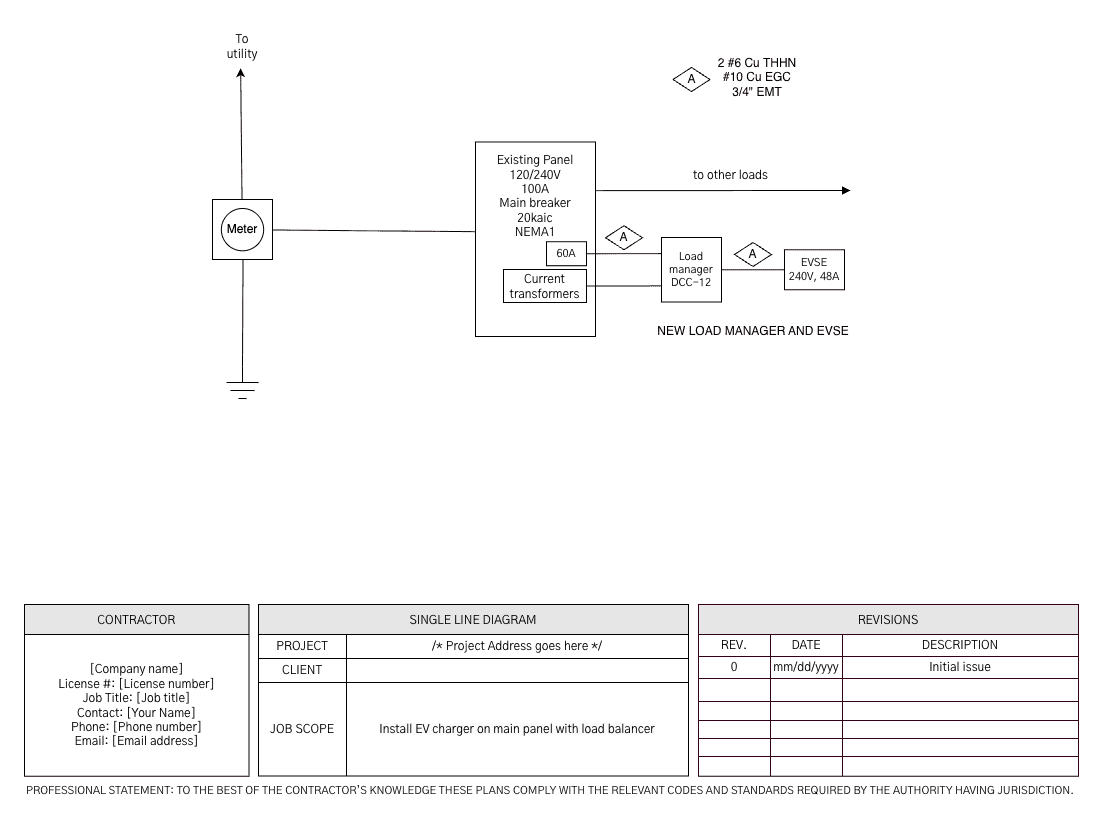
What's in this EV charger with load balancer single line diagram template
The template shows the EV circuit leaving the main panel through a load balancer before it reaches the charger.
- Utility connection and meter
- Existing 120/240V, 100A main panel with main breaker, 20kAIC, NEMA 1
- 60A EV breaker in the main panel
- Current transformers at the main panel, wired to the load balancer
- New DCC-12 load balancer between the 60A breaker and the EVSE
- New 240V, 48A EVSE
- 2 #6 Cu THHN and a #10 Cu EGC in 3/4" EMT from the breaker to the load balancer and on to the EVSE
- Feed to the home's other loads
- Grounding at the meter
- Title block with contractor, project, and revision info
Every label is editable to match the job.
Looking for a different template?
Access our template libraryHow to use our single line diagram drawing tool
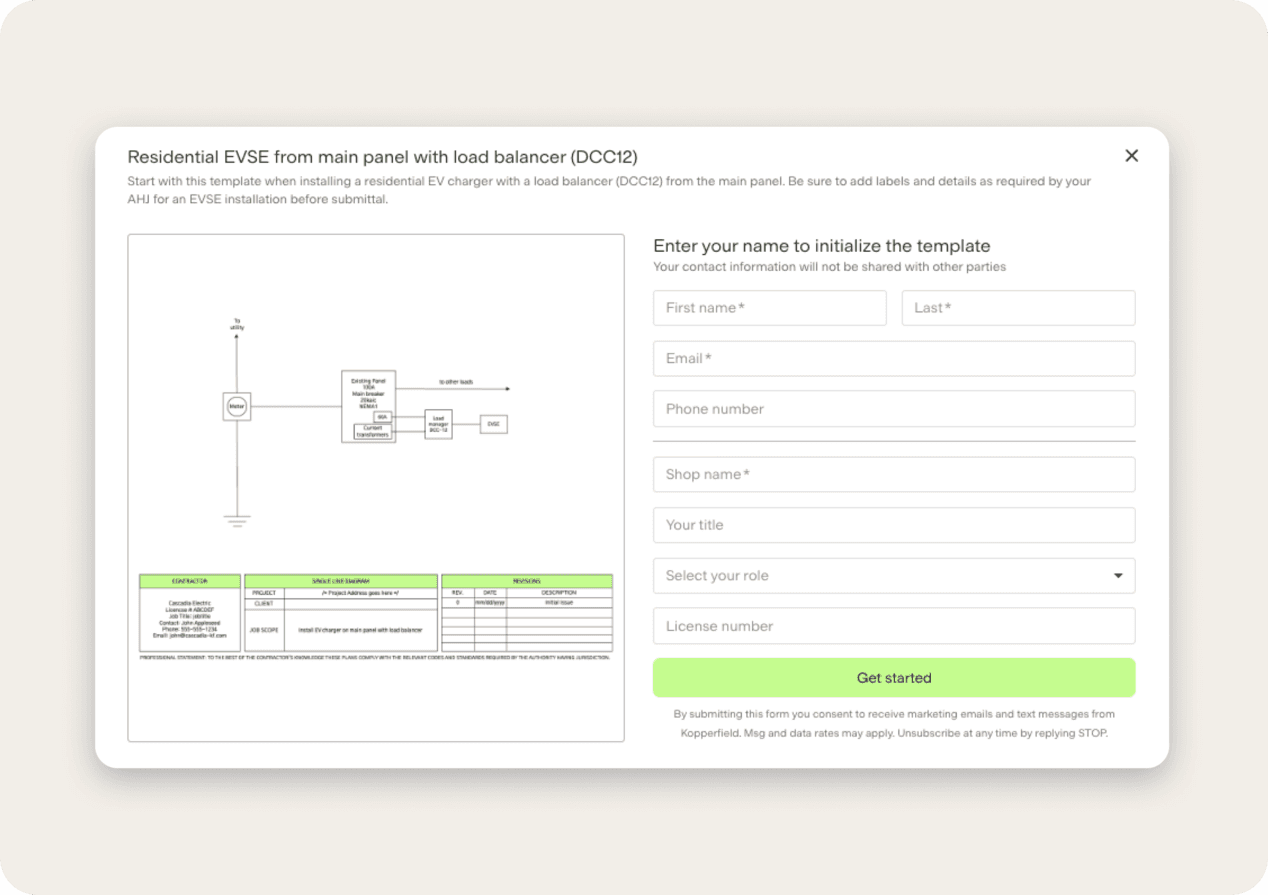
Use free templateEnter your email for free template access
Pick this template and enter your email. You'll create a free account, and your shop info gets added to the PDF.
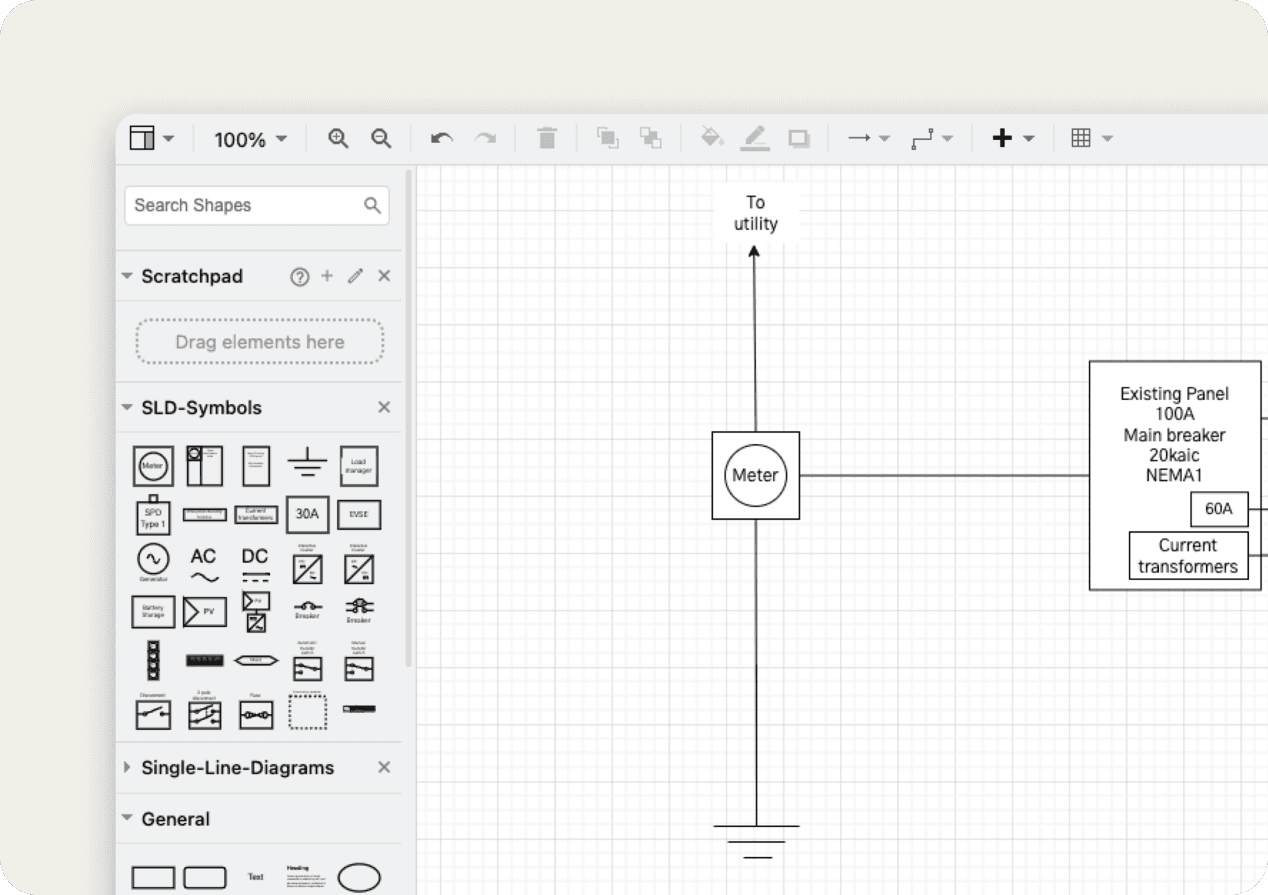
Edit your diagram
Update symbols, breaker and panel sizes, colors, and comments to match the job.
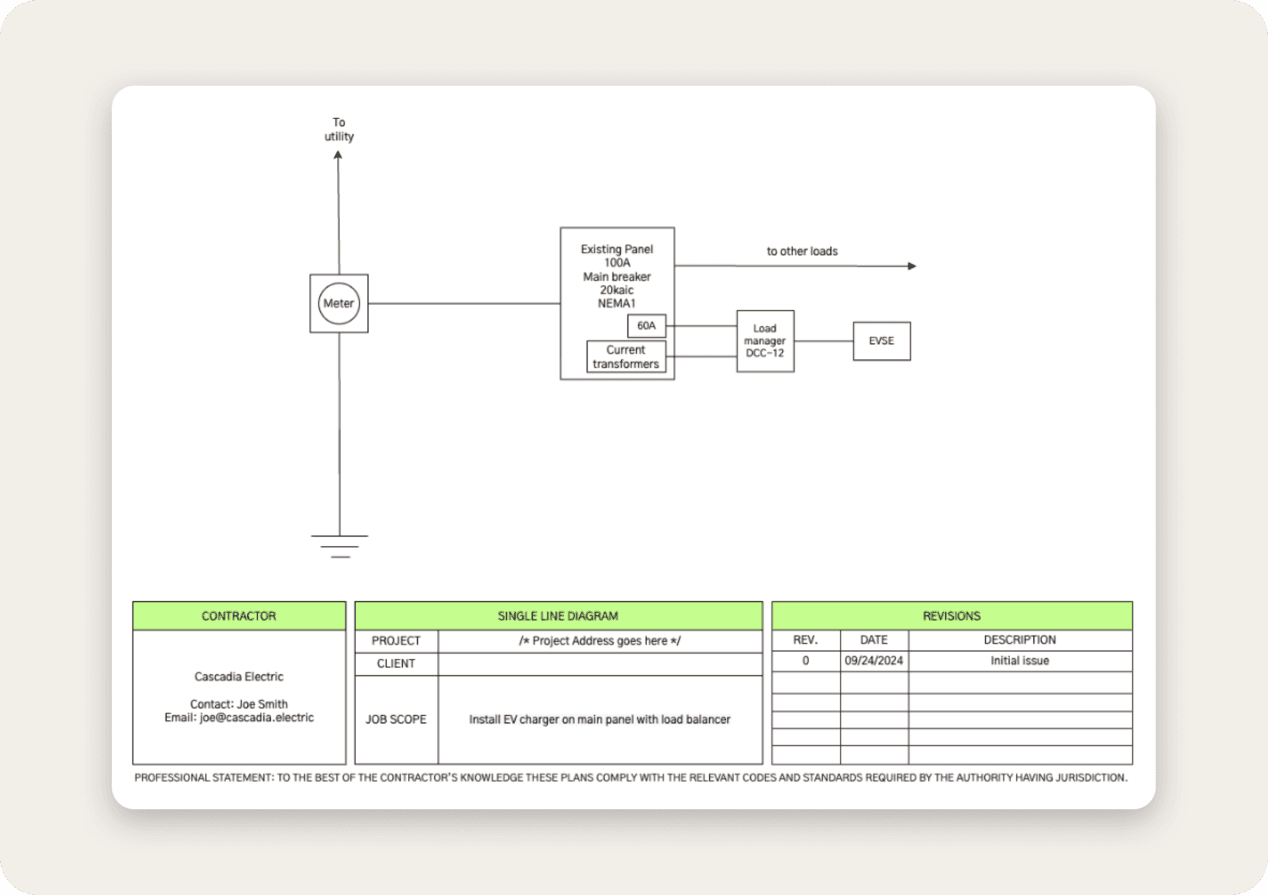
Get your free, shareable PDF
Finish the title block and we'll generate a free PDF you can attach to your permit application.
Free templates that save you time
Pre-built templates
Choose a template from common scenarios like service and panel upgrades and EV charger, solar, generator, and battery installs
Easy drawing tools
Create, edit, and share diagrams and drawings faster with standard symbols and drawing components
Custom shop branding
Personalize diagrams and documents with project details and shop branding and customize to meet the needs of your AHJ
Downloadable PDF
Generate a free PDF of your diagram to send to customers or use for permit applications
More EV charger single line diagram templates
EV charger with load balancer single line diagram FAQ
More questions? Email team@kopperfield.com and we'll get back to you.
Can I add an EV charger to a 100A panel without a service upgrade?
Often, yes. A load balancer like the DCC-12 de-energizes the charger when the home's load gets above 80% of the main breaker rating, which can avoid a service or panel upgrade. Check your AHJ and utility requirements first.
What is an EV energy management system?
An EV energy management system (EVEMS), also called EV load management, monitors a home's electrical load and pauses or limits EV charging so the total stays within the service capacity. The DCC-12 load balancer in this template is one example.
What is a DCC-12?
The DCC-12 is a load balancer for EV chargers in single-family homes. It works with main breakers up to 200A and EV breakers up to 60A, and it comes in a NEMA 3R enclosure for indoor or outdoor installs. It has no built-in breaker, so the EV breaker stays in the panel.
What is the difference between a DCC-12 and a DCC-9?
The DCC-12 is for single-family homes and connects at the home's panel. The DCC-9 is for condo and apartment units and connects on the load side of the unit's meter. For a unit in a building with a meter bank, use the condo and apartment EV charger template.
Does the NEC count the full EV charger load if you use a load balancer?
Not always. The 2023 NEC 625.42(A) sets the EVSE load on a service or feeder at the maximum allowed by an energy management system that meets 750.30. Confirm which NEC edition your AHJ uses and whether they accept the DCC-12 as the energy management system in your load calc.
What is an electrical single line diagram?
A single line diagram (or one line diagram) is a simplified, easy-to-read graphical representation of an electrical power distribution system. It uses single lines and standard symbols to illustrate the key components such as transformers, circuit breakers, and power sources. A single line diagram provides a clear overview of how electrical power flows within a system and is essential for power system design, maintenance, and troubleshooting.
How do I use the single line diagram tool?
To start using our single line diagram tool, pick the template you’d like to edit from the gallery. Enter your email to begin editing. Select shapes and symbols from the left sidebar and drag these into the center of the page to edit the diagram. Select shapes to edit their style, text, or arrangement from the right sidebar. Save, preview, and send your completed diagram to email from the menu on the top right of the screen. If you need additional assistance, check out our guide to creating single line diagrams, which covers the symbol library and drawing tools.
Who is this tool made for?
This tool is made for professionals involved in the design, construction, and permitting of electrical upgrades. This includes electrical contractors, engineers, power system designers, maintenance technicians, and designers. Our tool makes it easy for anyone to create single line diagrams with simple drawing tools and features.